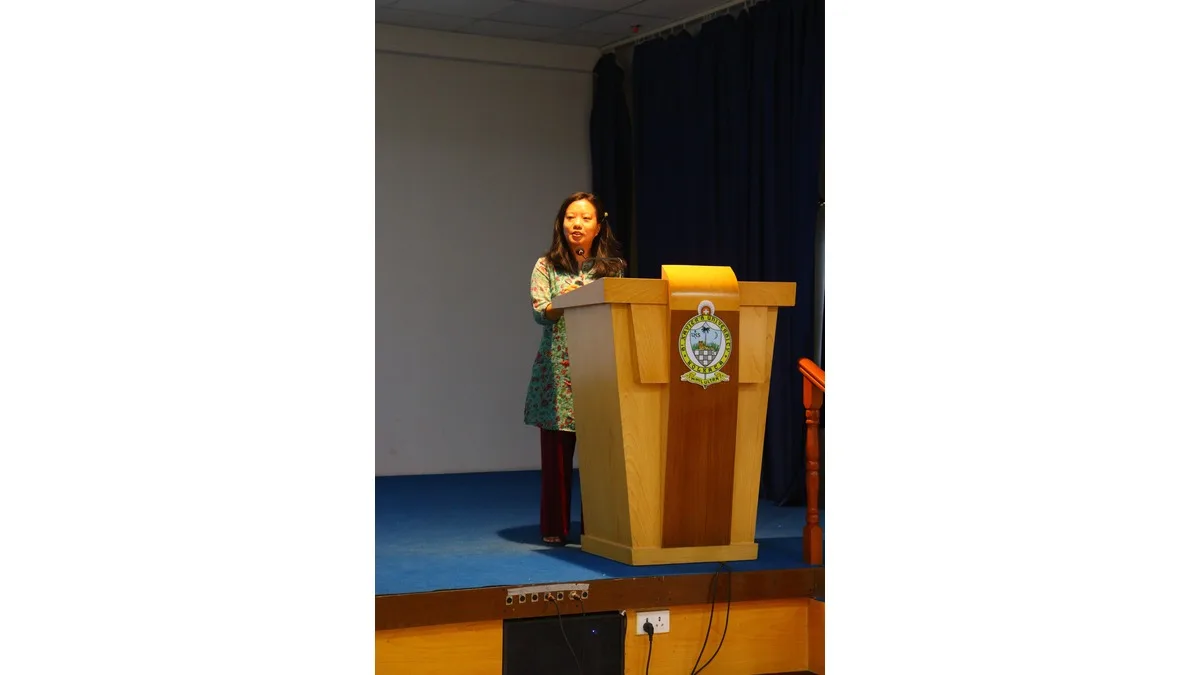
In an evocative blend of artistry and activism, St. Xavier’s University, Kolkata, played host to a ground-breaking feminist photography workshop recently, organised by the Department of English under the guidance of Head of the Department Prof. Medha Bhadra Chowdhury. The day-long workshop aimed to dismantle patriarchal narratives ingrained in visual culture, reclaim female subjectivity, and challenge the male gaze.
The event, held at the university campus, began on a note of reverence and purpose with the ceremonial lighting of the prayer lamp.
Advertisement
What followed was an intellectually stirring engagement led by the keynote speaker and workshop conductor, Millo Ankha — a renowned documentary photographer, educator, and founder of the AAMA Collective. Well known for her visual documentation of Northeast India and Darjeeling, Ankha highlighted a diverse tapestry of indigenous identity, feminist criticism, and artistic expression.
Drawing from her own roots in the Apatani tribe of Arunachal Pradesh, Ankha addressed the first part of the session by unpacking the theoretical frameworks that mould feminist visual narratives. Candidly opening up about her origin, Ankha stressed the history of her tribe- how tattooed bodies of the Apatani women, which once stood as a cultural and social emblem, are now on the verge of extinction. While tattoos may have been their primary evidence of identification, she questioned the generalisation behind it- “Our bodies were our language,” she asserted, her voice resonating through the packed auditorium. “But what happens when the world only reads one meaning into our skin?”
From colonial documentation to war reportage, Ankha’s talk skilfully navigated the history of photography, highlighting how the medium has historically been marshalled to document conflict and disaster, frequently overlooking the intimate realities. She urged the participants to look beyond traditional subjects and compositions, claiming that feminist photography must aim to confront the human psyche and expose the naked truth through its lens of transparency and raw approach.
Crucially, she challenged what has traditionally been deemed deserving of photographic attention by stressing the analytical tools required for decoding images — the lens, the gaze, and the frame — while also emphasising the significance of capturing ‘anything and everything.’ Citing Virginia Woolf’s claim that women require ‘a room of one’s own,’ Ankha compared the progressive reclamation of space and vision by female photographers in a formerly male-dominated field.
Students from St. Xavier’s University, as well as La Martinière for Girls and Hiralal Mazumdar College for Women, enthusiastically participated in the workshop. The diverse range of viewpoints at the event was further enhanced by a number of independent researchers and photography enthusiasts.
The second session shifted gears from theoretical to practical. In a dynamic and exciting hands-on exercise, participants were asked to venture across the campus and engage in a guided photography walk, where they could click pictures wherever their minds led them to. After they were done clicking pictures, Ankha invited the audience to display their photographs and build a literary narrative around them, thus fixating the audience in an engaging and fruitful discussion.
This immersive segment encouraged attendees to rethink representation- to question what stories are conveyed through images and, more crucially, by whom. Participants challenged the conventional idea of gaze and reoriented visual storytelling toward inclusivity and intersectionality by documenting everything, from everyday interactions to hidden corners of the university.
In a lively reflection circle that followed the exercise, participants shared their photographs and talked about how they attempted to assert female subjectivity and regain narrative agency. Every picture, whether it was of a classroom’s empty bench drenched in the sombre light of the monsoon sky or the complexities of a tall, lone tree in the reflection of rainwater, became a story—private, political, and potent.
The Head of the Department of English, Prof. Medha Bhadra Chowdhury, said, “Feminism as a theoretical framework can be complex, particularly for young people who have not yet been initiated in the discipline. The photography workshop, therefore, was a way of demonstrating simply and effectively how a feminist approach could shift perspectives and influence social understanding.”